Solar energy is becoming an increasingly practical option for homeowners, businesses, institutions and industries looking to reduce their dependence on conventional electricity. In Uttar Pradesh, the growing availability of rooftop solar programmes, government incentives and financing options has made solar power more accessible to residential consumers.
A solar energy company in Uttar Pradesh can help homeowners and businesses design and install rooftop solar systems based on electricity consumption, available roof space and budget. Residential consumers may be eligible for central assistance under PM Surya Ghar and additional Uttar Pradesh support, subject to current eligibility and programme rules. Before choosing a company, compare vendor eligibility, solar modules, inverter, installation quality, warranty, financing, subsidy assistance and after-sales service.
If you are searching for a solar energy company in Uttar Pradesh, you may have several questions: How much does a rooftop solar system cost? What is the solar panel installation cost? How much subsidy is available? Is a rooftop solar system for home suitable for your electricity consumption? And how do you choose the right solar company?
This guide explains the complete process of choosing and installing a rooftop solar system in Uttar Pradesh, including system types, installation, approximate costs, subsidies, financing and important factors to consider before making a decision.
According to the Uttar Pradesh New and Renewable Energy Development Agency (UPNEDA), rooftop solar systems can be installed on residential, commercial, institutional and industrial buildings. The state also provides support for residential rooftop solar through central and state government programmes.
What is a Rooftop Solar System?
A rooftop solar system is a photovoltaic (PV) electricity-generation system installed on the roof of a home, commercial building, institution or industrial property.
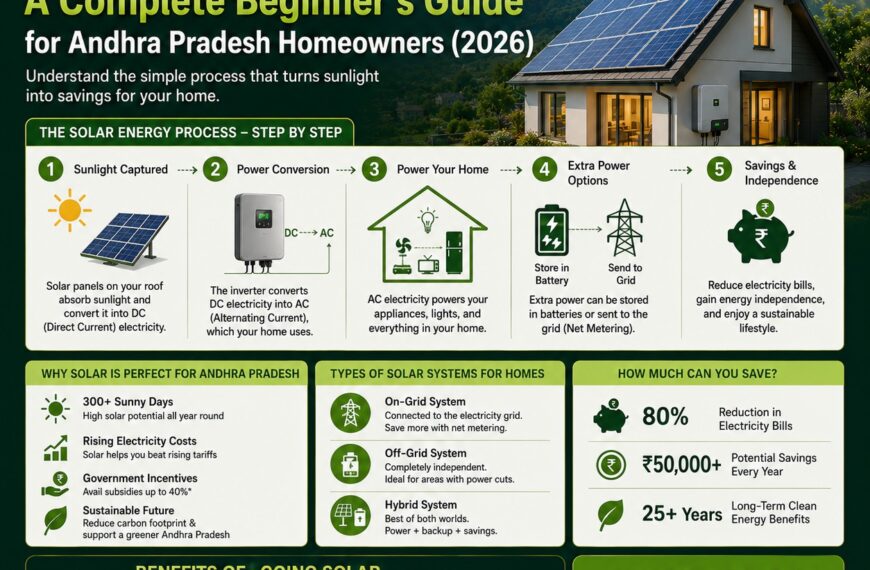
Solar panels convert sunlight into DC electricity. An inverter then converts this electricity into AC electricity that can be used by appliances and electrical equipment.
For a typical grid-connected system:
Sunlight → Solar Panels → Inverter → Home/Building → Grid
If the solar system generates more electricity than the property is consuming, the surplus may be exported to the electricity grid according to the applicable metering arrangement.
UPNEDA describes grid-connected rooftop solar as a system where electricity generated during the day is used for captive loads, with excess generation potentially being supplied to the grid.
Why Choose Rooftop Solar in Uttar Pradesh?
Uttar Pradesh has substantial potential for rooftop solar because homes, commercial buildings, institutions and industrial properties can use existing roof space for electricity generation.
A rooftop solar system can provide several benefits:
- Reduce dependence on grid electricity
- Lower electricity expenses over the long term
- Make use of unused rooftop space
- Generate clean and renewable electricity
- Potentially increase energy independence
- Reduce exposure to future increases in electricity costs
- Take advantage of applicable government incentives
- Support long-term sustainability goals
UPNEDA’s solar rooftop portal specifically highlights electricity-bill savings, use of vacant roof space and the long-term energy and environmental benefits of rooftop solar.
What is the benefit of installing rooftop solar in Uttar Pradesh?
Rooftop solar can help eligible homeowners reduce their dependence on grid electricity and potentially lower electricity expenses by generating power at the point of consumption. Residential consumers may also be eligible for applicable central and Uttar Pradesh government subsidies, subject to current scheme rules and eligibility. A professional solar company can assess the roof, electricity consumption, system size, installation requirements and applicable subsidy before installation.
Rooftop Solar System for Home: Is It Worth Considering?
For homeowners, a rooftop solar system for home can be particularly useful when electricity consumption is consistent and the property has sufficient shadow-free roof space.
Before installing solar, homeowners should consider:
1. Monthly electricity consumption
Review your electricity bills from the previous 6–12 months. This helps estimate an appropriate system size.
2. Available roof area
The roof should have adequate space with minimal shading from trees, adjacent buildings, water tanks or other structures.
UPNEDA’s FAQ indicates that approximately 10 square metres of roof area may be required per 1 kWp for a grid-connected rooftop solar system, although actual requirements vary depending on the system design and installation conditions.
3. Roof condition
The roof should be structurally suitable for mounting solar modules and associated equipment.
4. Electricity connection
Your sanctioned load, meter arrangement and local DISCOM requirements should be considered before finalising system capacity.
5. Available subsidy
Residential consumers should check their eligibility for applicable central and Uttar Pradesh government incentives before purchasing the system.
PM Surya Ghar Yojana and Rooftop Solar Subsidy in Uttar Pradesh
One of the most important considerations for residential consumers is the PM Surya Ghar Yojana, officially known as PM Surya Ghar: Muft Bijli Yojana.
The scheme supports residential rooftop solar adoption through central financial assistance, subject to applicable eligibility and programme conditions.
UPNEDA’s current solar rooftop portal states that residential consumers can receive central financial assistance of:
| Rooftop Solar Capacity | Central Subsidy |
|---|---|
| 1 kW | ₹30,000 |
| 2 kW | ₹60,000 |
| 3 kW | ₹78,000 |
| Above 3 kW | ₹78,000 fixed |
The same UPNEDA portal states that Uttar Pradesh provides an additional residential subsidy of ₹15,000 per kW, up to ₹30,000, over and above the central financial assistance. Eligibility, implementation conditions and applicable programme rules should always be verified before installation.
Important
Subsidy amounts and implementation procedures can change. Therefore, homeowners should verify the latest information through the official UPNEDA and PM Surya Ghar channels before making a purchase.
UPNEDA currently lists a dedicated Surya Ghar helpline: 155243, with service timings Monday to Saturday, 9:00 AM to 6:30 PM.
How Much Does Rooftop Solar Installation Cost in Uttar Pradesh?
The solar panel installation cost depends on several factors rather than just the price of solar panels.
Your total project cost may depend on:
- Solar system capacity
- Solar panel technology
- Inverter type and brand
- Mounting structure
- DC and AC cables
- Protection equipment
- Earthing and lightning protection
- Installation complexity
- Roof structure
- Metering requirements
- Transportation
- Monitoring equipment
- Warranty and after-sales service
Therefore, instead of comparing solar companies purely on the lowest quotation, homeowners should compare the complete system specification and total project value.
UPNEDA’s solar portal provides an indicative example of ₹60,000 per kWp for certain calculations, but actual market quotations can differ based on equipment, specifications, installation conditions and vendor.
Example
Suppose a homeowner requires a 3 kW rooftop solar system.
The final investment can be influenced by:
System size + equipment + installation + electrical work + applicable subsidy = effective project cost
This is why it is better to obtain a detailed quotation from an authorised/empanelled vendor rather than relying on a generic online solar panel price.
Solar Panel Price in India: What Should You Compare?
People often search for solar panel price in India, but the price of the panels is only one component of a complete rooftop solar project.
When comparing solar panels, consider:
Efficiency
Higher-efficiency modules can generate more electricity from limited roof space.
Technology
Different module technologies have different performance characteristics, warranties and pricing.
Warranty
Check both product warranty and performance warranty.
Manufacturer credentials
Consider the manufacturer’s reputation, certifications and availability of after-sales support.
Temperature performance
Solar panels operate under changing outdoor temperatures, so temperature-related performance specifications are worth reviewing.
Installation quality
Even a good solar panel can perform poorly if the system is incorrectly designed or installed.
The cheapest panel is not necessarily the lowest-cost solar solution over its complete operating life.
Solar Panel Installation Process in Uttar Pradesh
A professional solar panel installation generally involves several stages.
Step 1: Electricity Consumption Assessment
The installer reviews your electricity bills and determines your approximate energy requirement.
Step 2: Site Survey
The rooftop is assessed for:
- Available area
- Direction and orientation
- Shading
- Roof condition
- Electrical connection
- Structural requirements
Step 3: System Design
The solar company determines the appropriate:
- Solar capacity
- Number of modules
- Inverter capacity
- Mounting structure
- Electrical protection
- Cable requirements
Step 4: Subsidy and Application Process
For eligible residential projects, the application is processed through the applicable government/official rooftop solar process.
UPNEDA states that residential rooftop solar applicants are required to use an empanelled vendor under the applicable programme process.
Step 5: Vendor Selection and Installation
After the required approvals, the selected vendor installs the solar system.
Step 6: Inspection and Metering
The relevant DISCOM processes the required inspection and metering steps.
Step 7: Commissioning
After successful installation and required formalities, the system is commissioned.
Step 8: Subsidy Disbursement
For eligible consumers, applicable subsidy is processed according to the prevailing government procedure.
How to Choose a Solar Energy Company in Uttar Pradesh
Choosing the right solar energy company in Uttar Pradesh is one of the most important parts of the project.
Instead of selecting a company only because it advertises the lowest price, consider the following factors.
1. Vendor eligibility
For subsidy-linked residential installations, verify whether the vendor is authorised/empanelled under the applicable programme.
UPNEDA provides information on approved vendors for residential rooftop solar.
2. Product quality
Ask for complete specifications of the proposed:
- Solar modules
- Inverter
- Mounting structure
- Cables
- Protection devices
3. Installation experience
A good installation requires correct engineering, mounting, wiring, earthing and safety practices.
4. Warranty
Understand exactly what is covered and for how long.
5. After-sales service
Solar is a long-term investment. Check whether the company provides maintenance and technical support after installation.
6. Transparent quotation
The quotation should clearly explain what is included and excluded.
7. Government process support
If you are applying for a residential subsidy, ask the vendor how they will support the application, inspection, metering and commissioning process.
What Makes a Good Solar Company in India?
If you are comparing a solar company in India, look beyond marketing claims.
A reliable solar provider should ideally offer:
- Proper site assessment
- Transparent pricing
- Quality components
- Professional installation
- Appropriate system sizing
- Safety-focused electrical work
- Clear warranties
- Documentation
- Monitoring support
- Maintenance assistance
- Responsive after-sales service
For residential projects in Uttar Pradesh that involve government subsidy, it is especially important to verify the vendor’s status through the relevant official programme.
Best Solar Company in India: How Should You Compare Companies?
Searches such as “best solar company in India” are common, but there is no single company that is automatically the right choice for every consumer.
The appropriate solar provider depends on factors such as:
- Your location
- System size
- Budget
- Roof type
- Electricity consumption
- Required technology
- Warranty requirements
- Financing needs
- After-sales expectations
- Subsidy eligibility
A homeowner in Lucknow may have different requirements from a commercial customer in Noida, Kanpur, Agra, Varanasi or another part of Uttar Pradesh.
Therefore, compare companies using objective criteria instead of selecting a provider solely based on a “best company” claim.
Solar Financing: Can You Finance a Rooftop Solar System?
The upfront cost of solar can be a concern for many homeowners and businesses.
Depending on eligibility and lender policies, solar projects may be financed through:
- Home improvement loans
- Solar loans
- Renewable-energy financing
- Bank financing
- Consumer financing programmes
- Other eligible financing options
UPNEDA’s rooftop solar information notes that public-sector banks have been instructed to encourage eligible home/home-improvement borrowers to consider rooftop solar installations as part of applicable loan proposals.
When searching for the best solar finance company, don’t compare only the advertised interest rate. Also check:
- Processing fees
- Loan tenure
- EMI
- Prepayment conditions
- Documentation
- Eligibility
- Total repayment amount
- Whether the lender finances the complete system cost
- Whether subsidy treatment is clearly explained
Rooftop Solar Subsidy: What Homeowners Should Know
The rooftop solar subsidy can significantly reduce the effective cost of an eligible residential system.
However, consumers should remember that subsidy eligibility is not simply based on buying solar panels.
The project may involve:
Application → Vendor Selection → Approval → Installation → Inspection → Net Metering → Commissioning → Subsidy Processing
UPNEDA’s published rooftop solar process explains that the application is submitted through the designated process, the technical feasibility is handled by the concerned DISCOM, the system is installed after approval, and subsequent inspection/net-metering and commissioning steps are completed.
Net Metering and Rooftop Solar in Uttar Pradesh
Net metering allows electricity generated by a rooftop solar system to be accounted for against electricity consumed from the grid, subject to applicable regulations and consumer category.
For a grid-connected residential system, electricity generated during the day can first be consumed by the household. Depending on generation and consumption, surplus electricity may be exported to the grid.
UPNEDA explains that a bidirectional meter can measure electricity imported from and exported to the grid under the applicable arrangement.
The exact metering mechanism can differ by consumer category and prevailing regulations, so consumers should confirm the current requirements with their DISCOM/vendor.
How Much Roof Space Is Required for Solar?
Roof-space requirements depend on module dimensions, system capacity, mounting arrangement and site conditions.
As a general reference, UPNEDA states that around 10 square metres may be required for 1 kWp of grid-connected rooftop solar, meaning a 5 kWp system could require approximately 50 square metres of suitable roof area.
However, an actual site survey is necessary because:
- Shading affects usable area
- Walkways may be required
- Maintenance access should be considered
- Water tanks and other structures occupy space
- Roof orientation can affect layout
Solar Installation for Homes vs Businesses
| Factor | Home Rooftop Solar | Commercial/Industrial Solar |
|---|---|---|
| Primary objective | Reduce household electricity cost | Reduce operating electricity expense |
| Typical size | Smaller | Often larger |
| Subsidy | Residential programmes may apply | Eligibility differs |
| Electricity usage | Household appliances | Machinery, HVAC, lighting, equipment |
| Design | Residential load profile | Commercial/industrial load profile |
| Financing | Home/consumer/solar financing | Business/project financing |
| Metering | Subject to applicable residential rules | Depends on consumer category and regulations |
This distinction is important because solar subsidy in India is not necessarily available under the same conditions to every consumer category.
Common Mistakes to Avoid When Installing Rooftop Solar
Mistake 1: Choosing the cheapest quotation
A low initial price may not include every component or service.
Mistake 2: Ignoring electricity consumption
System sizing should be based on actual electricity usage.
Mistake 3: Not checking roof shading
Shading can reduce solar generation.
Mistake 4: Focusing only on panel price
A complete rooftop system includes much more than panels.
Mistake 5: Ignoring inverter quality
The inverter is a critical part of a grid-connected solar system.
Mistake 6: Not checking warranties
Always understand product, performance and inverter warranties.
Mistake 7: Choosing an unverified vendor
For subsidy-linked residential projects, check the applicable approved/empanelled vendor requirements.
Mistake 8: Ignoring after-sales service
Solar is a long-term installation, so service support matters.
Why Professional Solar Installation Matters
Professional installation can influence the safety, performance and long-term reliability of a rooftop solar system.
An experienced installer should pay attention to:
- Structural mounting
- Panel orientation
- Cable management
- Earthing
- Lightning protection
- DC and AC protection
- Inverter placement
- Waterproofing considerations
- Electrical safety
- Maintenance accessibility
The objective should not simply be to install panels on a roof. The objective is to create a properly designed and safely integrated solar power system.
How to Calculate Whether Rooftop Solar Makes Financial Sense
A basic solar investment evaluation can consider:
Annual electricity savings + applicable financial incentives + other benefits
compared with
Initial system investment + financing cost + maintenance expenses
The resulting payback period depends on:
- System cost
- Electricity tariff
- Annual solar generation
- Household consumption
- Self-consumption level
- Export/metering arrangement
- Subsidy
- Financing cost
- System performance
UPNEDA’s solar portal provides users with tools to explore rooftop potential, estimated savings and indicative payback information.
What Questions Should You Ask a Solar Company Before Installation?
Before signing a solar installation contract, ask:
- Is the company/vendor authorised or empanelled for the applicable programme?
- What solar system capacity is being recommended?
- Why is this capacity suitable for my electricity consumption?
- Which solar panels will be installed?
- Which inverter will be used?
- What warranties are included?
- Does the quotation include installation?
- Does it include mounting structures and electrical protection?
- Who handles the subsidy application?
- Who handles net-metering documentation?
- What after-sales service is provided?
- What maintenance is required?
- What happens if a component fails?
- What is the expected annual generation?
- What is the total project cost after applicable subsidy?
Getting these answers in writing makes it easier to compare different solar companies objectively.
Future of Rooftop Solar in Uttar Pradesh
The adoption of rooftop solar is likely to remain an important part of India’s renewable-energy transition.
For Uttar Pradesh, rooftop solar offers an opportunity to use existing building infrastructure for decentralised electricity generation.
Government initiatives, solar financing, improving solar technology and greater consumer awareness can make rooftop solar increasingly accessible to households and businesses.
UPNEDA’s current solar portal also promotes rooftop solar adoption and provides tools for residents to evaluate rooftop potential and financial benefits.
Frequently Asked Questions
1. Which is the best solar energy company in Uttar Pradesh?
The appropriate solar company depends on your location, system size, budget, equipment requirements, subsidy eligibility and after-sales expectations. Compare authorised/empanelled status where applicable, product specifications, warranties, installation quality and service before selecting a provider.
2. How much does solar panel installation cost in Uttar Pradesh?
The cost depends on system capacity, panels, inverter, mounting structure, electrical equipment, installation and other site-specific requirements. Government subsidy, where applicable, can reduce the effective cost for eligible residential consumers.
3. What is the solar subsidy in Uttar Pradesh?
UPNEDA’s current solar rooftop portal states that eligible residential consumers can receive central financial assistance of up to ₹78,000, along with Uttar Pradesh state support of ₹15,000 per kW up to ₹30,000, subject to applicable conditions.
4. What is PM Surya Ghar Yojana?
PM Surya Ghar: Muft Bijli Yojana is a Government of India rooftop solar programme that provides central financial assistance for eligible residential rooftop solar installations.
5. Is rooftop solar suitable for a home?
Yes, rooftop solar can be suitable for homes with adequate shadow-free roof space and suitable electricity consumption. A professional site assessment can determine the appropriate system capacity.
6. How much roof space is required for a solar system?
As a general reference, UPNEDA states that approximately 10 square metres of roof area may be required for 1 kWp of grid-connected rooftop solar. Actual requirements depend on the system design and site conditions.
7. Can I get a loan for rooftop solar?
Financing options may be available through banks and other financial institutions, depending on eligibility and lender policies. Consumers should compare interest rates, processing fees, tenure and total repayment cost.
8. Does rooftop solar work when the grid is available?
Yes. A grid-connected rooftop solar system can supply electricity to the property’s loads while also interacting with the electricity grid according to the applicable metering arrangement.
9. What should I check before choosing a solar company?
Check vendor eligibility, product specifications, warranties, installation experience, quotation transparency, subsidy support, metering assistance and after-sales service.
10. Is solar panel price the same as the total solar installation cost?
No. Solar panels are only one component of a complete rooftop solar system. The total project cost can also include the inverter, mounting structure, cables, protection equipment, installation, electrical work and other services.
Conclusion
Choosing a solar energy company in Uttar Pradesh is an important decision because a rooftop solar system is a long-term investment. Instead of focusing only on solar panel price in India or the lowest installation quotation, homeowners should evaluate the complete system, including equipment quality, installation standards, warranty, subsidy eligibility, financing and after-sales support.
For residential consumers, programmes such as PM Surya Ghar Yojana and Uttar Pradesh’s rooftop solar support can make the economics of solar more attractive, subject to prevailing eligibility requirements.
The right approach is simple: understand your electricity consumption, assess your rooftop, compare complete quotations, verify the vendor and understand the subsidy and financing terms before installation.
A qualified solar company in Uttar Pradesh can then help you select and install a rooftop solar system designed around your property’s actual energy requirements.

 By
By



 By
By